
Churn Is a Symptom, Not the Problem: What SaaS Teams Keep Missing
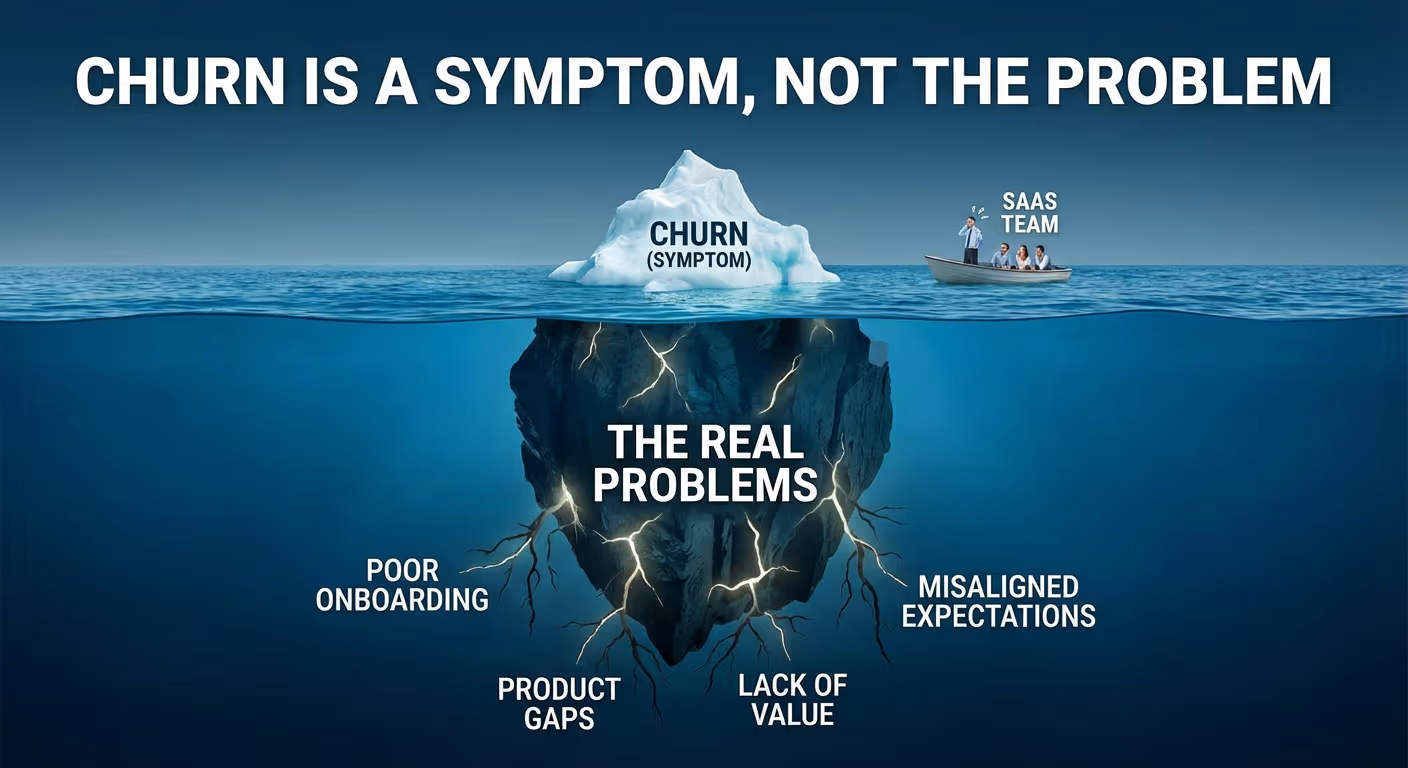
Most SaaS teams treat churn like a discrete event: a customer cancels, you log a reason, you try to “save” the next one. But churn rarely begins at cancellation. It’s typically the final observable outcome of problems that started weeks—or months—earlier: mis-sold expectations, slow time-to-value, weak adoption loops, or incentives that push the wrong behaviors.
A useful mental model: churn is a lagging indicator. The drivers are leading indicators—product usage patterns, stakeholder changes, value realization milestones, and the gap between promised and experienced outcomes.
Below is a data-driven way to think about churn and the deeper issues behind it, with SaaS examples, diagnostic questions for CSMs, and a practical framework to identify true churn drivers.
Why churn isn’t the “root cause”
When a customer says “too expensive,” “not using it,” or “we’re consolidating tools,” those are often exit narratives, not root causes. Price sensitivity rises when value is unclear. “Not using it” is an adoption failure that usually traces back to onboarding, enablement, or product fit. Consolidation hits hardest when your product is not deeply embedded in workflows.
In practice, churn is usually caused by one (or more) of these deeper categories:
- Product-market fit (PMF) mismatch for that segment/use case
- Onboarding gaps that delay or prevent habit formation
- Poor value realization (no measurable outcomes)
- Misaligned KPIs between customer, CSM, Sales, and product usage reality
Let’s unpack each.
1) Product-market fit gaps: “They were never a great fit”
Even products with strong overall PMF can have weak fit for specific segments or use cases. Churn concentrates where fit is weakest: customers with ambiguous use cases, low urgency, low internal maturity, or a job-to-be-done your product supports only partially.
What it looks like in SaaS
- Customers buy based on broad positioning (“all-in-one platform”), but their specific workflow requires depth you don’t have.
- The champion loves the product, but the rest of the org doesn’t adopt because the tool doesn’t match how work is actually done.
- Adoption never reaches a “default tool” threshold; usage stays shallow.
Example pattern
A horizontal analytics or automation tool signs many SMBs quickly. The churn spike appears 2–4 months later. Exit reasons: “we didn’t have time” or “we didn’t see value.” Root cause: a subset of customers needed heavy implementation or data maturity that SMB teams didn’t have. The product fit was fine for data-forward teams, weak for the rest.
Leading indicators of PMF mismatch
- Repeated “custom” workflows and workarounds
- Many support tickets about missing core capabilities (not bugs)
- Low activation rates across a cohort even with strong CSM effort
- High variability in time-to-first-value (TTFV)
Diagnostic questions for CSMs
- What job did they hire us to do, and is that job still urgent?
- Which alternative are we replacing—and why were they dissatisfied with it?
- What does success look like in their terms (time saved, revenue, risk reduction)?
- If they renewed today, what would they do differently? (If they can’t answer, fit is shaky.)
2) Onboarding gaps: “They never formed the habit”
Onboarding is not a checklist—it’s the process that turns intent into sustained behavior. In most SaaS, churn correlates strongly with whether the customer reaches an activation milestone and whether that milestone leads to repeated use by the right personas.
Common onboarding failure modes
- Implementation finishes, but workflows don’t change (tool is “installed,” not adopted)
- Training focuses on features, not outcomes
- The wrong users are enabled (champion trained, end users ignored)
- No clear “first success” moment
Example pattern
A project management SaaS sells to department heads. Onboarding trains admins, but not frontline users. The account appears “green” early (kickoff completed), then usage stagnates. At renewal, leadership says, “We didn’t get the team to use it,” and cancels.
Leading indicators of onboarding-driven churn
- Low week-2/week-4 retention of active users
- Activation completed by admin only; end-user adoption remains low
- High time-to-value relative to contract length (e.g., 90-day value in a 12-month contract might be fine; in a monthly plan it’s fatal)
- No recurring cadence established (QBRs/EBRs never happen)
Diagnostic questions
- Who must change behavior for value to happen? Have they changed yet?
- What’s the smallest repeatable workflow that proves value?
- What does “day 7” usage look like? Day 30?
- If the champion left tomorrow, would usage continue?
3) Poor value realization: “They can’t prove ROI (even if value exists)”
Value can be real yet invisible. Many churned customers don’t say “we got no value”—they say “we couldn’t justify it.” That’s a measurement and storytelling failure as much as a product issue.
Where value realization breaks
- Outcomes are not tied to baseline metrics
- Customer doesn’t operationalize the product (no processes or accountability)
- You deliver outputs (reports, dashboards) instead of outcomes (decisions, actions)
- Value is delayed beyond the customer’s patience horizon (especially for SMB)
Example pattern
A customer support platform improves response times and deflects tickets, but the customer never sets up tracking or connects it to labor savings. At renewal, finance asks: “What did we get for this line item?” The champion can’t quantify, so it gets cut during budget tightening.
Leading indicators
- No agreed success plan with measurable targets
- QBRs focus on features shipped, not outcomes achieved
- Health score relies on activity metrics only (logins) rather than impact metrics (tickets deflected, time saved, pipeline influenced)
- Expansion opportunities stall because value narrative is weak
Diagnostic questions
- What metric moved since implementation, and by how much?
- What was the baseline? Do we trust the data source?
- Who signs off on ROI internally (finance, ops, exec sponsor)? Have we shown them?
- What would make renewal an “easy yes” for procurement?
4) Misaligned KPIs: “Everyone’s ‘winning’—but the customer isn’t”
Churn often happens when internal KPIs optimize for the wrong thing:
- Sales comp optimizes for closing deals (even if fit is marginal)
- CSM KPIs optimize for activity (touches, QBRs) rather than outcomes
- Product optimizes for roadmap velocity or usage volume, not value creation
- The customer optimizes for business outcomes, not “adoption”
When KPIs conflict, you get predictable churn:
- Customers are sold a future state the product can’t deliver quickly
- CSMs inherit accounts that require heavy consulting but lack capacity
- “Green” accounts churn because health scores track the wrong signals
Example pattern
A SaaS company uses a health score heavily weighted toward logins and seat utilization. An account shows “healthy,” but the executive sponsor never sees business impact. Procurement cuts the contract. The churn was not caused by adoption—it was caused by missing executive value alignment.
Leading indicators
- “Green” accounts with low executive engagement
- High feature usage but low renewal confidence
- Frequent re-scoping of success criteria mid-contract
- Success plans that don’t map to customer KPIs
Diagnostic questions
- What KPI does the customer care about that our product influences directly?
- Which of our internal KPIs could push us to do the wrong thing for them?
- Who owns the outcome on their side? Is that person engaged?
- Does our success plan survive leadership changes?
Practical framework: Identify the true churn drivers (not just the reasons)
Here’s a lightweight framework CSM teams can run per account before renewal risk appears.
Step 1: Separate “reason” from “driver”
- Reason = what the customer says at cancellation (price, consolidation, not using)
- Driver = what changed (or never happened) that made renewal unjustifiable
Create a simple mapping table internally:
- “Too expensive” → weak ROI proof, low realized value, wrong segment, weak champion
- “Not using” → onboarding failure, no workflow integration, wrong personas trained
- “Consolidating” → not embedded, not differentiated, weak exec sponsorship
Step 2: Diagnose across four driver categories (PMF, onboarding, value, KPIs)
Score each category 0–2:
- PMF fit clarity: use case defined, urgency real, alternatives understood
- Onboarding execution: activation achieved, right users enabled, habits formed
- Value realization: baseline + targets + measured outcomes, ROI story delivered
- KPI alignment: exec sponsor engaged, success plan tied to business outcomes
A low score in any category is a likely churn driver. Two lows is a churn trap.
Step 3: Validate with leading indicators (not opinions)
Pick 3–5 leading indicators you trust (examples):
- Activation milestone completion within X days
- Weekly active users in key persona group
- Feature/workflow adoption tied to outcome
- Exec sponsor touchpoints per quarter
- ROI metric tracked from a shared dashboard or report
If sentiment is good but indicators are weak, treat it as risk. Sentiment often lags reality until renewal pressure arrives.
Step 4: Build an intervention tied to the driver
- PMF mismatch: re-scope to a narrower, winnable use case; adjust package; or exit early
- Onboarding gap: restructure onboarding around “first success,” role-based enablement, and workflow integration
- Value gap: baseline + target + monthly value review; instrument outcomes; create an exec-ready ROI narrative
- KPI misalignment: reset success plan, align stakeholders, and change internal CSM playbooks/health scoring
Examples of churn driver narratives (what good looks like)
Example A: “Churned due to budget”
- Surface reason: budget freeze
- True driver: value not proven to finance; no quantified outcomes; exec sponsor disengaged
- Fix: establish baseline in month 1, track outcome monthly, deliver a 1-page renewal justification by month 8
Example B: “Churned due to low usage”
- Surface reason: adoption low
- True driver: onboarding trained champion only; no workflow integration; time-to-value too long
- Fix: re-onboard end users, implement a single workflow, set weekly usage goal tied to outcome
Example C: “Churned due to consolidation”
- Surface reason: moving to suite vendor
- True driver: product not embedded; differentiation unclear; no expansion path; stakeholders not aligned
- Fix: focus on differentiated value, integrate into core systems, build multi-threaded relationships early
A short checklist of diagnostic questions (copy/paste for CSMs)
Fit & expectations
- What job-to-be-done are we solving, and is it still a priority?
- What did Sales promise, and what has been delivered?
- What would a “win” look like by renewal?
Onboarding & adoption
- Who are the 3 critical personas, and are they active?
- What’s the customer’s first recurring workflow in-product?
- What is preventing habit formation (time, data, permissions, process)?
Value realization
- What baseline metric did we capture at kickoff?
- What metric improved, by how much, and who agrees it matters?
- Can the champion explain ROI in 30 seconds to finance?
Stakeholders & KPIs
- Who is the exec sponsor and when did we last review outcomes with them?
- If the champion leaves, do we still have power and adoption?
- What internal KPI are we optimizing that may be misaligned with customer outcomes?
Closing: Treat churn as a lagging signal and build a leading-indicator system
Churn reduction doesn’t come from better “save plays” at the end. It comes from systematically improving:
- who you sell to (PMF segmentation),
- how you activate them (onboarding that creates habits),
- how you prove impact (value realization),
- and how you align incentives (KPIs that prioritize customer outcomes).
Stay Ahead in Customer Success


Lorem ipsum dolor sit amet, consectetur adipiscing elit. Suspendisse varius.