
From Support to Strategy: How Modern CSM Teams Drive Revenue in 2025
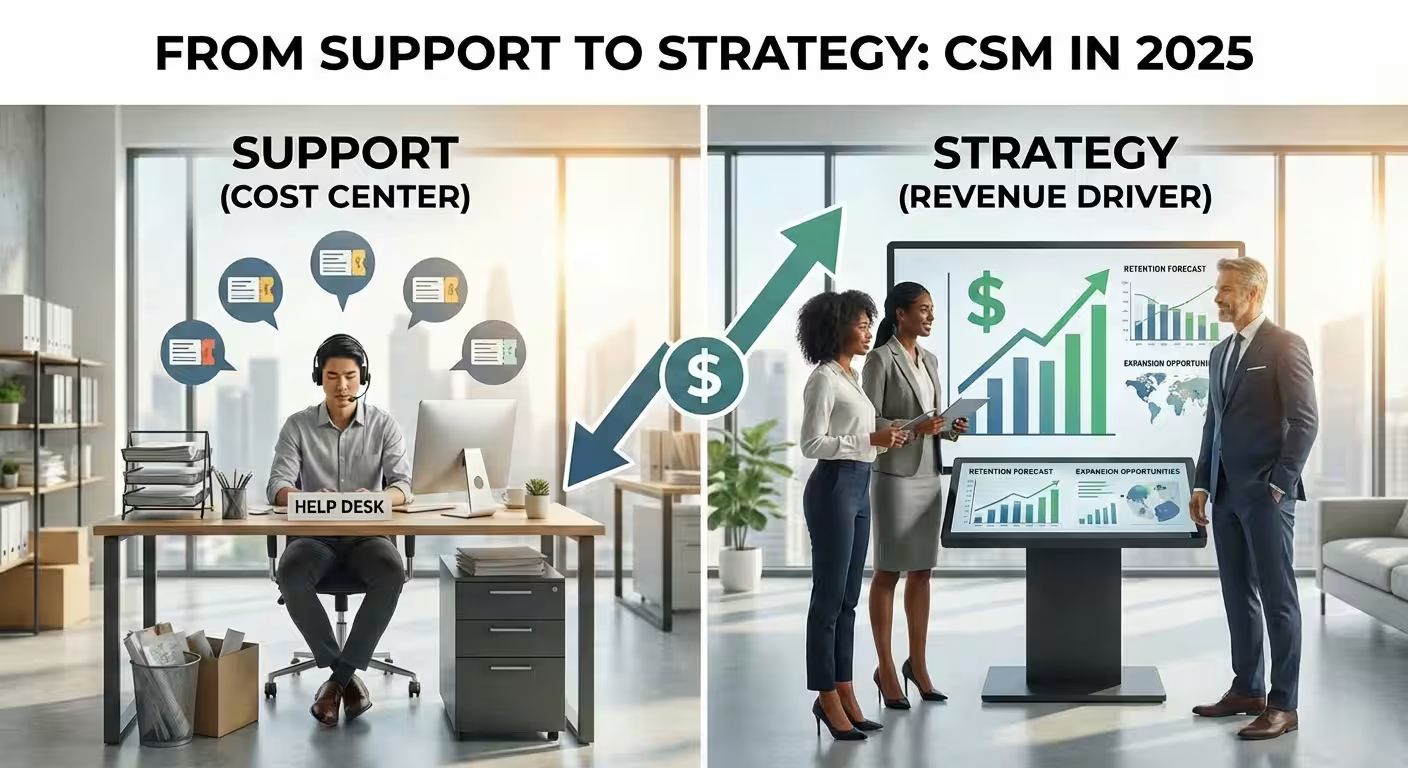
Customer Success (CS) has undergone a fundamental identity shift. What began as a post-sale safety net—answering tickets, running check-ins, and handling renewals—has become a core lever of modern SaaS growth. In 2025, the strongest companies treat Customer Success as a strategic revenue function: accountable for retention, expansion, and net revenue outcomes, powered by forecasting discipline, product-led signals, and tight cross-functional alignment.
This evolution didn’t happen because CS wanted a bigger seat at the table. It happened because SaaS economics demanded it. As acquisition costs rose and growth became harder to buy, expansion and retention became the most efficient sources of durable revenue—and CS is uniquely positioned to influence both.
Below is how CS evolved, what “strategic CS” looks like today, and the trends reshaping the function in 2025—plus actionable moves SaaS leaders can make now.
1) The evolution: from support to outcomes to revenue
Phase 1: Reactive support (the early model)
CS was often indistinguishable from support or account management:
- Handle issues when customers complain
- Run basic onboarding
- Show up near renewal when risk appears
Success was measured by activity (“touches,” “meetings,” “QBRs”) and subjective sentiment.
Phase 2: Proactive adoption and value realization
As competition grew, CS shifted to driving product usage and measurable outcomes:
- Structured onboarding and adoption playbooks
- Customer education programs
- QBRs focused on outcomes and ROI narratives
Health scores started to appear, but many were simplistic (logins, seats used).
Phase 3 (2025): Strategic revenue function
Now CS is expected to drive business results:
- Expansion motion ownership (in partnership with Sales)
- Retention forecasting with quantified risk
- Operationalized customer health tied to renewal likelihood and usage-to-value signals
- Cross-functional orchestration across Sales, Product, Marketing, Support, and Finance
In other words: CS is increasingly the function that translates product value into renewable revenue.
2) Expansion: CS as the engine of durable growth
Expansion is no longer “nice to have.” In many SaaS models, it’s the difference between acceptable and elite performance.
How expansion has matured in CS
- From “upsell when they’re happy” to expansion-by-design
- From generic QBR decks to commercial value narratives connected to business KPIs
- From opportunistic seat adds to use-case expansion (new workflows, teams, geos, modules)
What strategic expansion looks like
- CS identifies expansion based on leading indicators: adoption depth, feature traction in adjacent teams, outcome attainment, stakeholder engagement, and procurement readiness.
- Expansion plays are timed around customer moments: hitting ROI milestones, successful rollouts, leadership changes, fiscal planning, contract anniversaries.
Where leaders get it wrong
- Treating CS as “not commercial” while expecting expansion outcomes
- Incentivizing expansion without giving CS the tools (pricing clarity, product packaging, enablement, deal desk support)
- Confusing usage with readiness (usage can be high and renewal still at risk if exec value isn’t clear)
Best practice
Define a clear partnership model with Sales:
- CS owns value realization, multi-threading, and opportunity discovery
- Sales (or AM) owns pricing, negotiation, and closing mechanics
- Shared pipeline governance and mutual SLAs prevent dropped handoffs
3) Retention forecasting: from surprise churn to predictable renewal math
In 2025, retention is treated like a forecastable number—not a retrospective metric.
Why forecasting matters
Forecasting changes behavior. When renewal risk becomes visible early, teams can:
- intervene earlier (before the customer mentally churns)
- allocate resources intelligently
- reduce “end-of-quarter heroics”
- build more credible revenue projections for leadership and finance
What strong retention forecasting includes
- A renewal pipeline with stages (e.g., Confirmed / Likely / At Risk / Critical)
- Quantified renewal probability per account
- Cohort-based churn expectations (by segment, tenure, use case, implementation type)
- Leading indicators that update the forecast dynamically
Common failure modes
- Forecasting based on CSM sentiment alone
- Health scores that don’t correlate with renewal outcomes
- No definition of what “risk” means (or inconsistent risk criteria across reps)
- Forecasts updated too late to change outcomes
A practical approach
Start with a simple probabilistic renewal model:
- Combine usage-to-value indicators, executive engagement, support signals, and commercial factors (discount levels, renewal uplift, vendor consolidation risk)
- Calibrate it quarterly against actual churn/renewal outcomes
Even a basic model that’s consistently used beats a complex model no one trusts.
4) Customer health scores: from dashboards to decision systems
Health scores are everywhere—but many don’t work because they measure activity instead of value and risk.
In 2025, “health” is shifting from:
- Single score → multi-signal health profile
- Static snapshot → trend-based risk detection
- Vanity usage → outcome-linked adoption
- CS-owned → company-shared operating metric
What effective health scores include
- Adoption depth (workflow completion, key feature usage, breadth across roles)
- Value realization (KPI movement vs baseline; milestones achieved)
- Stakeholder strength (multi-threading, exec sponsor engagement, champion risk)
- Support risk (severity, time-to-resolution, recurring issues)
- Commercial risk (procurement signals, pricing pressure, contract structure, consolidation)
Key point
A health score should drive decisions:
- Which accounts get a CSM’s proactive time?
- Which accounts need exec attention?
- Which accounts are expansion-ready?
- Which accounts should be moved to tech-touch?
If “health” doesn’t change how you operate weekly, it’s just reporting.
5) Cross-functional collaboration: CS as the connective tissue
Strategic CS sits at the intersection of customer reality and internal execution. That forces a more mature relationship with both Sales and Product.
CS + Sales: shared revenue outcomes
High-performing orgs clarify:
- Role boundaries (who owns renewal, who owns expansion, who owns negotiation)
- Shared account plans and mutual SLAs
- One pipeline view for renewals + expansion + risk
This reduces the classic dysfunction:
- Sales pushes for the close; CS inherits poor fit
- CS identifies value; Sales shows up only at contract time
- Customers experience disjointed messaging
CS + Product: feedback that drives roadmap decisions
In 2025, Product teams increasingly demand that CS feedback be:
- structured (not anecdotes)
- quantified (impact and frequency)
- segmented (which ICP, which use case, which tier)
- tied to revenue impact (risk, expansion, retention lift)
Strong CS orgs run a clear “Voice of Customer” loop:
- recurring themes + revenue-weighted impact
- top friction points in onboarding
- feature adoption blockers
- competitive displacement patterns
This turns CS into a growth multiplier rather than a complaint inbox.
Trends shaping Customer Success in 2025
Here are the patterns SaaS leaders are leaning into right now:
1) Outcome-based CS (value engineering becomes mainstream)
More CS teams are building ROI plans with:
- baselines
- targets
- milestone checkpoints
- executive-ready narratives
Value realization is being operationalized, not improvised.
2) AI-assisted CS operations (but workflow-first)
AI is increasingly used to:
- summarize calls and extract risks
- draft follow-ups and success plans
- flag churn signals from usage + support + CRM
- recommend next-best actions
The winners are not “AI everywhere” teams—they’re teams that integrate AI into consistent playbooks.
3) Segmented service models: high-touch + scaled CS + digital success
Companies are splitting CS delivery based on:
- ACV and complexity
- implementation needs
- product maturity and self-serve capability
Scaled CS becomes a profit center when paired with strong onboarding and product instrumentation.
4) Retention and expansion are converging into “customer revenue”
Instead of separate motions, many orgs now manage:
- Renewal + expansion forecasting in one operating rhythm
- a single customer revenue number aligned to finance planning
5) Health scores become “renewal likelihood systems”
Health scores are being rebuilt around:
- renewal probability
- expansion readiness
- risk drivers that correlate to churn
Less “pretty dashboards,” more decision-grade signals.
6) CS becomes more cross-functional and finance-aligned
CS leaders increasingly work closely with:
- RevOps (data, instrumentation, pipeline governance)
- Finance (forecasting, renewals planning, unit economics)
- Product (adoption loops and retention levers)
Actionable takeaways for SaaS leaders
If you want CS to operate as a strategic revenue function, these are the moves that matter most:
- Define what CS owns—explicitly
- Renewal ownership? Expansion ownership? Commercial negotiation?
Ambiguity creates churn and internal conflict.
- Renewal ownership? Expansion ownership? Commercial negotiation?
- Instrument value, not just usage
- Tie key product behaviors to outcomes (time saved, revenue influenced, risk reduced).
- Build success plans that track baseline → target → achieved.
- Build a retention forecasting cadence
- Weekly renewal pipeline review with probability and drivers.
- Standard definitions for “At Risk” and “Critical.”
- Escalation paths that trigger early.
- Rebuild health scoring around correlation to churn/renewal
- Validate health signals against historical renewals.
- Prefer trends over snapshots.
- Include stakeholder and commercial signals, not just activity.
- Create a clean CS–Sales partnership model
- Shared account planning.
- SLAs for handoffs.
- Joint expansion pipeline governance.
- Operationalize Voice of Customer into Product
- Revenue-weight customer issues.
- Segment by ICP/use case.
- Provide Product with actionable, repeatable insights.
- Segment your CS delivery model
- High-touch where complexity demands it.
- Tech-touch where product and onboarding are strong.
- Don’t treat all accounts the same—it’s expensive and ineffective.
Closing
Customer Success in 2025 is less about being helpful after the sale and more about creating, proving, and renewing value at scale. The most effective CS orgs behave like revenue teams: they forecast, measure outcomes, coordinate cross-functionally, and drive expansion with discipline.
If you share your SaaS model (PLG vs sales-led), customer segments, and renewal/expansion ownership today, I can propose:
- a practical CS operating cadence,
- a health score blueprint,
- and a retention + expansion forecasting template aligned to your setup.
Stay Ahead in Customer Success


Lorem ipsum dolor sit amet, consectetur adipiscing elit. Suspendisse varius.